Back to bulletin
Xiaoxin Chen
Xiaoxin Chen's Journey with the Lute
Our member Xiaoxin Chen shares his experience making and restoring lutes.
Our member Xiaoxin Chen shares his experience making and restoring lutes.
Xiaoxin Chen began as an enthusiast of the violin and the classical guitar, with a particular passion for the latter. Around 2010, through the internet and a handful of Chinese guitar books, he gradually came into contact with the lute and with early music. At the time, Chinese-language material on the subject was scarce, and even those books mentioned the lute and vihuela only in passing — but already he had begun to hope that one day he would be able to play the lute himself.
Around 2014, he bought his first lute from a foreign workshop and began formal practice. As his playing deepened, he came to feel that the instrument had significant shortcomings in structure, feel, and sound, which led to a very direct impulse: since he loved playing so much, he wanted to make a better lute — one that truly suited him and that would satisfy him as a player. From 2015 onwards he began to study woodworking techniques, and took his first practical steps by building an Irish harp. In 2016 he turned seriously to the lute itself, acquiring museum drawings of original instruments from abroad and learning by building.
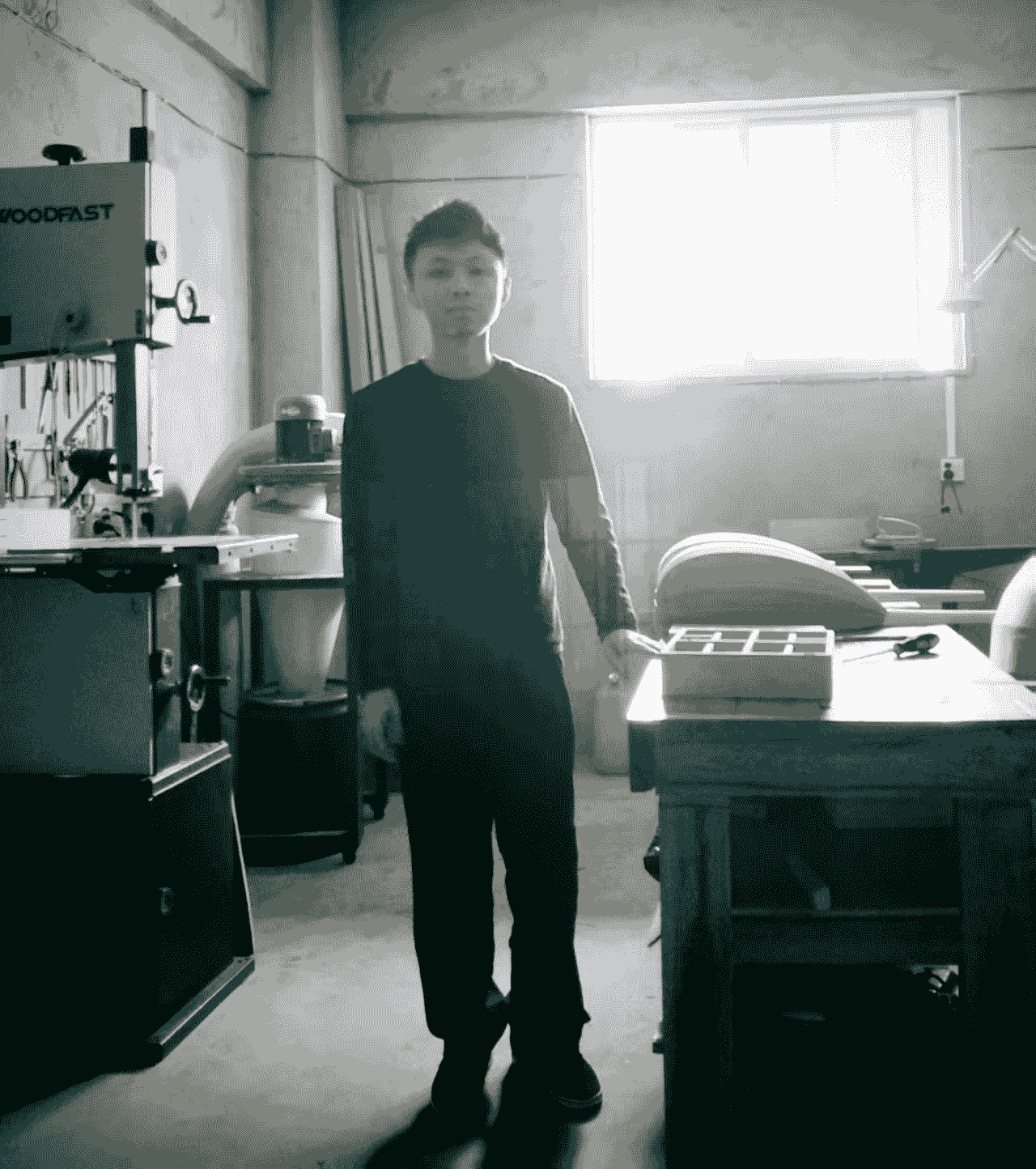 The most distinctive — and most difficult — part of lute making lies in the instrument's elegant half-pear-shaped body. Different models and sizes call for different contour designs and different ways of joining the ribs; the work involves shop drawings, mould design, rose carving, wood preparation, hand carving, CNC operations, tuning-peg making, finishing, and surface treatment. His first Renaissance lute took him roughly four months to complete. Afterwards he continued to experiment with new models, gradually focusing his research on the Renaissance lute, the Baroque lute, the theorbo, and related historical instruments.
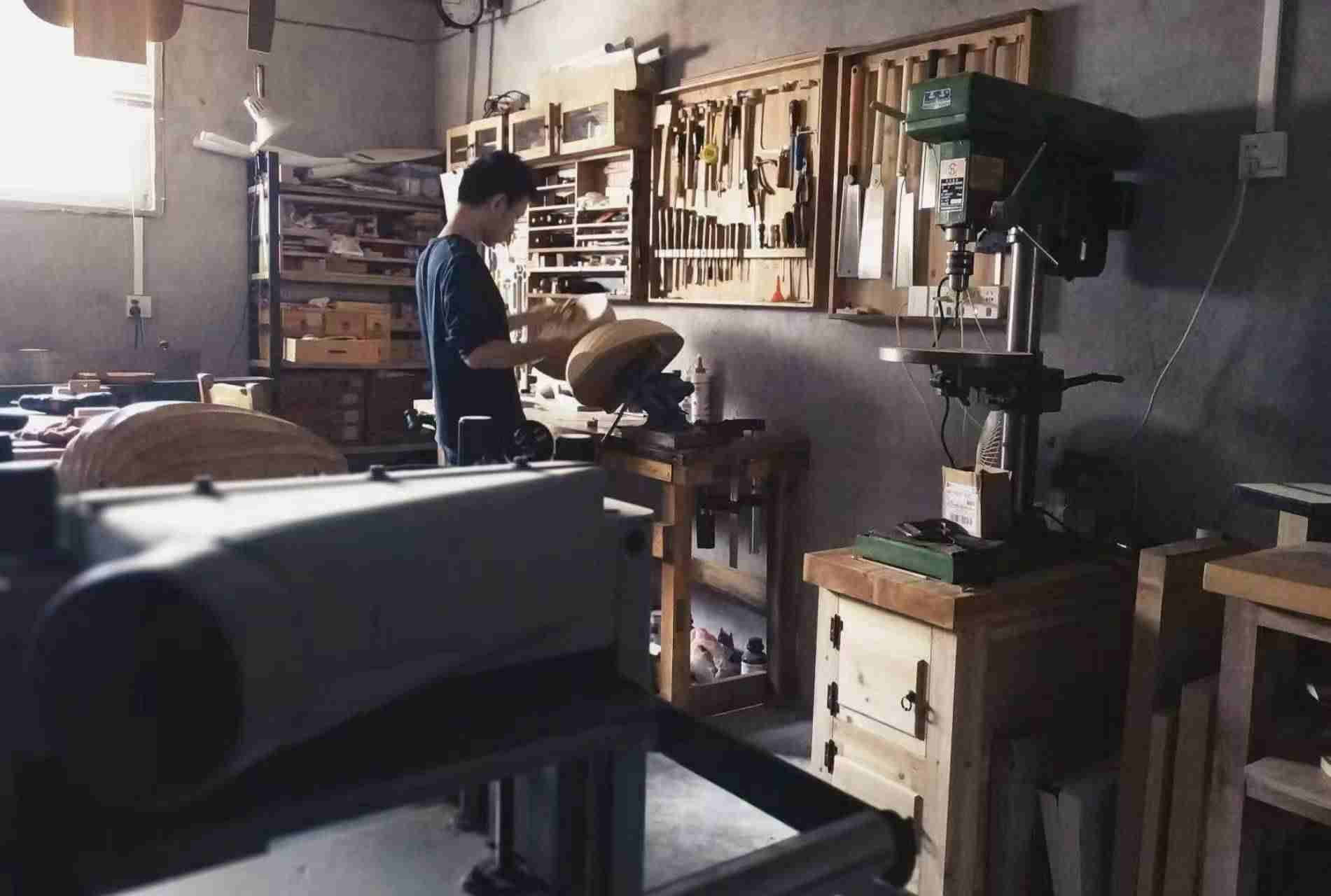
Since 2018, he has worked from a more permanent studio and has begun making lutes more systematically for fellow players. Orders have come mainly from mainland China, as well as from Hong Kong, Taiwan, and Southeast Asia. Alongside this, he has gradually moved into restoration work as well. In order to learn proper repair methods, he first carried out repeated dismantling and repair experiments on his own instruments, building up experience before accepting commissions. For him, this path was not the product of ready-made conditions; it began from "I love playing," and step by step grew into "I make my own instruments, and I restore my own instruments." In the end, what has sustained everything is very simple: because the love is real, he is willing to keep going.