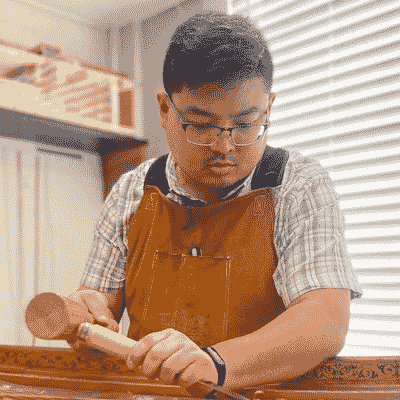
Zhengyi Hou has recently published a new article in Early Music,
"Matteo Ricci's gravicembalo and manicordio: new discoveries and a reconsideration,"
offering fresh material and a new interpretive framework for Matteo Ricci's introduction of European keyboard instruments to Ming-dynasty China.
Article Summary
The article revisits a long-standing question in the history of music and Sino-Western cultural exchange:
what kind of keyboard instrument did Ricci actually present to the Ming court, and was there truly only one?
Drawing on Ricci's own writings and later accounts, earlier scholarship has generally assumed that the instrument brought to the imperial court in 1601 was a single Western keyboard instrument, usually identified as a harpsichord or a clavichord. Working from recently accessible Chinese sources, Hou points instead to traces of another related instrument that had already appeared in Nanjing in 1599, arguing that the episode calls for a more careful distinction and reconstruction.
The significance of the article lies not only in disentangling the terms gravicembalo and manicordio, but in correcting a historical narrative that has long been oversimplified. Through close reading of Chinese sources and a comparative analysis of different editions of Ricci's China Journal, Hou argues that the Nanjing accounts of 1599 and the court records of 1600 – 1601 should be examined separately, opening the way to a renewed understanding of how European keyboard instruments were disseminated in China through Ricci's activities.
In other words, this is not a simple "correction of terminology" but a comprehensive reinterpretation that touches on the history of material culture, textual transmission, musical dissemination, and Sino-European cultural diplomacy. It allows us to see more clearly that late-Ming China's earliest reception of European instruments was not a single event, but a more complex and more deserving process of exchange than has previously been recognized.